
From seed to frame
How a print is made
A Linden Frame print goes through five stages, in the same order every time. Very little of the work is the drawing itself. Most of it is checking.
Generating the image
Each series has its own small program, written by Mara and kept deliberately plain; the Ridgelines program is under four hundred lines. It takes a seed, a palette and a handful of settings: how many layers, how rough the ridges are, where the light sits, how much haze there is between one layer and the next.
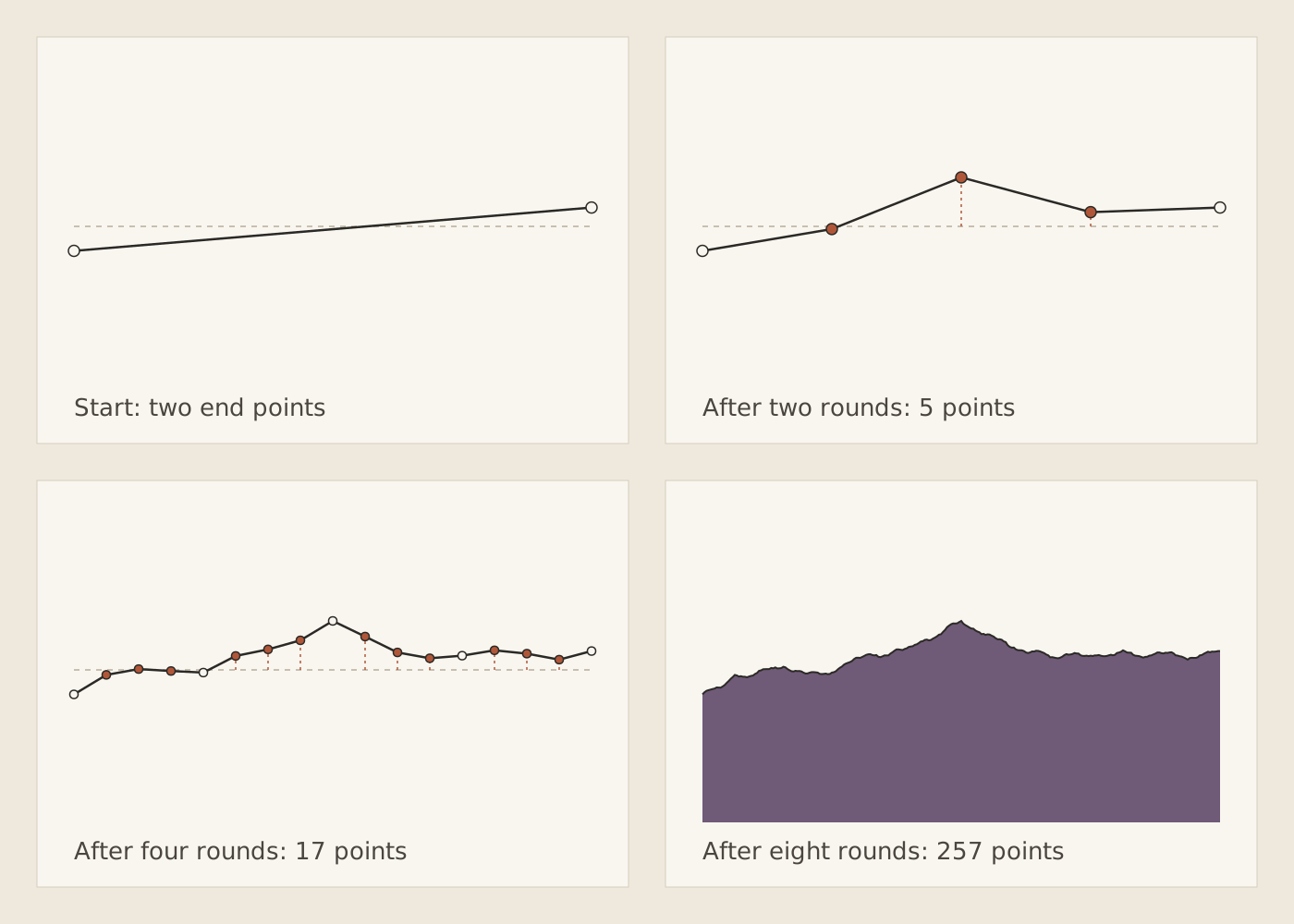
A ridge starts as a straight line between two points. The program splits it in the middle and moves the new midpoint up or down by a random amount. Then it splits each half and does the same, with the movement shrinking every round. After eight rounds the line has 257 points and looks like a mountain. How fast the movement shrinks decides the character of the range: we use a factor of about 0.53, which gives old, weathered ridges rather than young, jagged peaks.
The random numbers are not truly random. They come from a sequence that starts from the seed, so the same seed and settings always produce exactly the same image. That matters for printing: the program writes a vector file, and the 50 × 70 cm print is the same drawing as the A4, generated again at the larger size rather than enlarged.
Grain is added last, as two layers of very small dots that repeat at different intervals so the pattern never visibly lines up. On paper it reads as a texture in the colour rather than as noise.
For each print we keep, we look at two or three hundred seeds.
Proofing
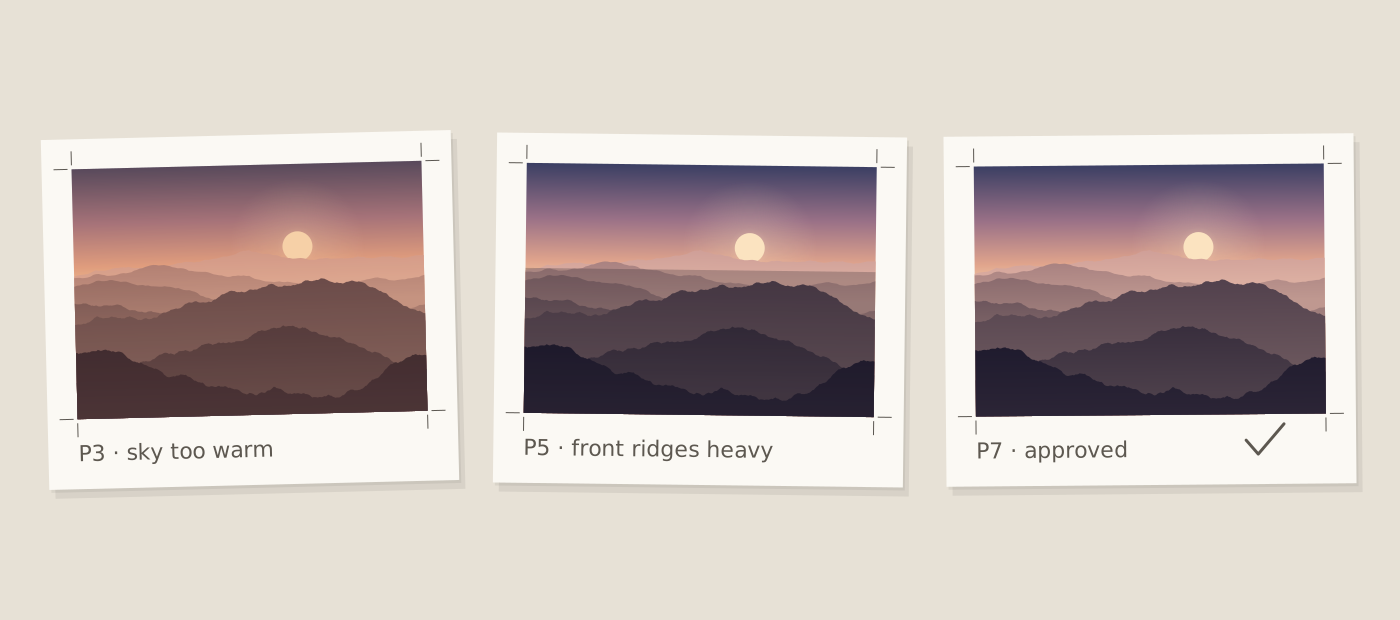
Candidates are first printed small, about postcard size, and pinned to the studio wall with others from the same batch. They stay there for at least a week. Images that look striking on a screen often go flat on paper; quieter ones sometimes get better every day.
The ones we keep are proofed at full size on the paper they will be printed on. Each proof is looked at in two lights: under a 5000 K viewing lamp, and by a north-facing window in the afternoon. A proof that looks right under the lamp but turns green by the window goes back.
Corrections are made in the program, not in an image editor. If a sky prints too warm, its colour is changed in the palette and the image is generated again from the same seed. A print usually takes between four and nine proofs. Proofs are marked, dated and kept in a plan chest; they are never sold.
Paper
We use two papers, both 100% cotton, acid-free and matte. Ridgelines and Winter Fields are printed on a smooth 310 gsm sheet in a natural white. River Light is printed on a 300 gsm sheet with a light texture and a slightly warmer tone, which suits the low morning colours of that series.
Neither paper contains optical brighteners. Brighteners make white paper look cleaner and bluer when it is new, but they fade, and over the years the sheet drifts back toward a warmer tone. A natural white looks a little softer on the first day and stays the way it is.
Paper is stored flat in the clean room of the workshop, away from the woodworking dust, and left in the room for a day before printing so it has settled to the same humidity as the printer.
- Fibre
- 100% cotton
- Weight
- 310 gsm smooth, 300 gsm textured
- Surface
- Matte, no brighteners
- Sizes
- A4, A3, 50 × 70 cm
Pigment inks
Prints are made on a large-format inkjet printer with a ten-colour pigment ink set. Pigment inks sit on the surface of the paper as tiny solid particles instead of soaking into it as dyes do, which makes them far more resistant to fading. Kept out of direct sunlight, a pigment print on cotton paper holds its colour for many decades.
Pale images are the hardest to print well. In Winter Fields the difference between the snow and the sky is only a few percent of ink, laid down mostly as light grey and light cyan, and a small shift in humidity shows up as a colour cast. We print an edition size in one session wherever we can, and compare the first and last sheets against the approved proof.
After printing, sheets rest face up for twenty-four hours before they are handled again, so the ink can settle completely. Each print is then signed and numbered in pencil on the back, together with its seed.
Framing in linden
Linden, called lime in Britain and basswood in North America, is a pale, fine-grained hardwood that carvers have used for centuries. It has very little figure, so it doesn't compete with the image, and once dry it stays stable. It is also soft, which is why our frames have slightly eased edges: a sharp corner on linden dents the first time it meets a door frame.
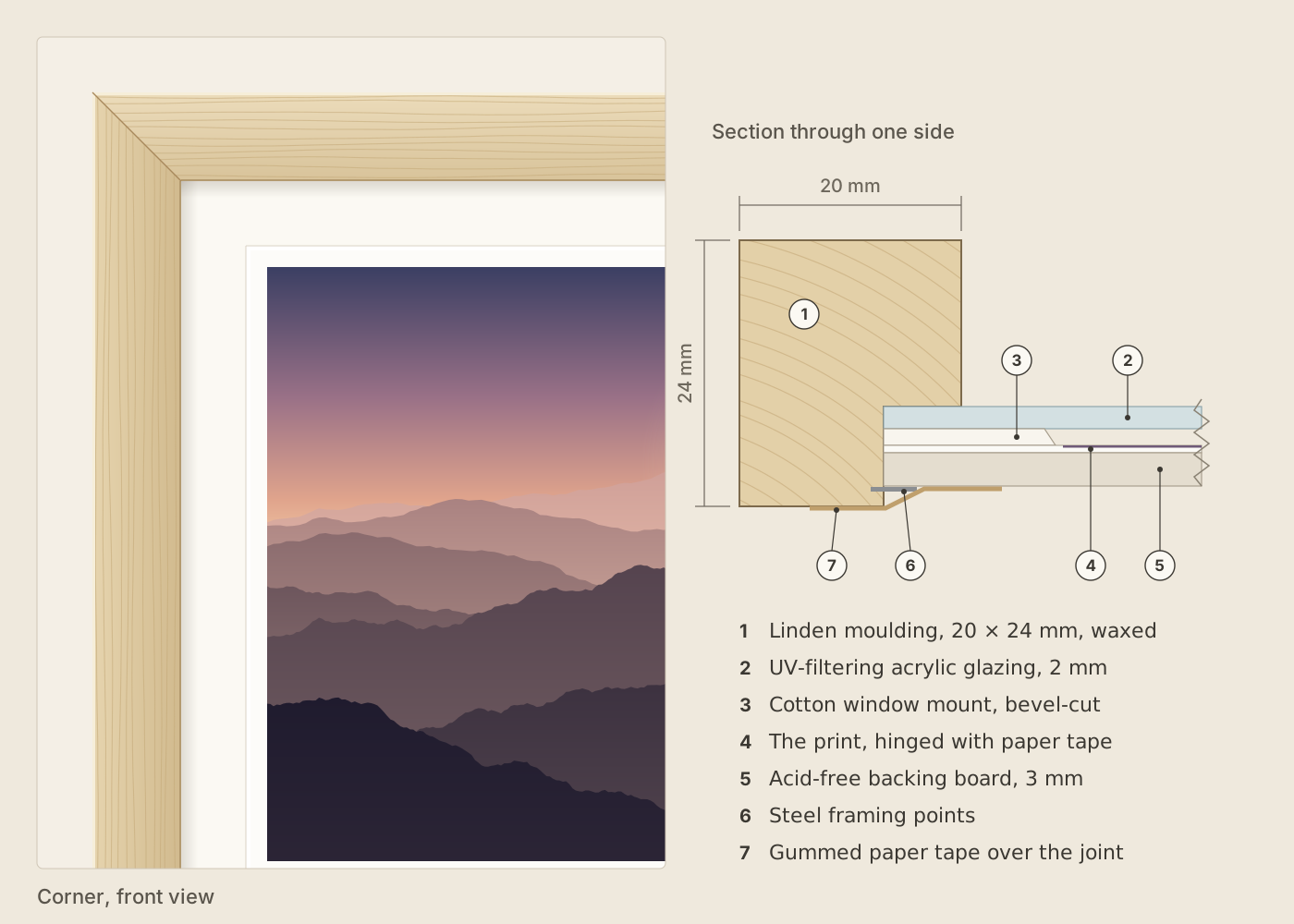
Jonas buys kiln-dried boards and lets them settle in the workshop for several weeks. They are ripped and planed into a plain square profile, 20 mm wide and 24 mm deep, with a rebate 7 mm wide and 9 mm deep cut in two passes on the table saw. The corners are mitred, glued and pinned from the back with V-nails. The only finish is a thin coat of hard wax oil, which keeps the wood pale and takes away the dry, chalky look of raw linden.
Inside the frame: UV-filtering acrylic glazing, a cotton window mount with a bevelled opening, the print hinged to an acid-free backing board with paper tape, and steel framing points to hold it all in place. The back is sealed with gummed paper tape against dust and carries a label with the title, edition number, size and seed.
We frame in batches of ten to fifteen, because that is how many frames come out of one run of boards. You can read about a recent batch in the journal.