
Seven ridges, one seed
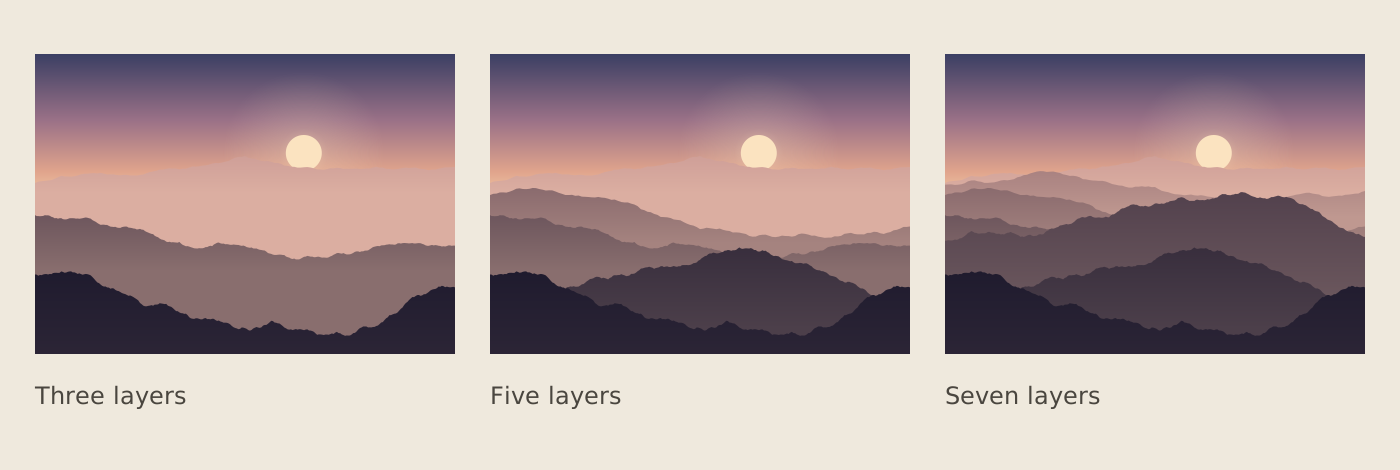
When the Ridgelines program first worked, it would draw as many ridges as I asked for, so of course I asked for a lot. The early test prints had twelve, fifteen, once twenty-two layers, and every one of them looked like a stage set: flats of painted mountains standing in front of a backdrop, very neat, with no air between them.
The problem wasn't the number on its own. It was what each extra layer did to the haze. The program colours ridges by distance. The nearest gets the darkest colour in the palette, the farthest is almost the colour of the sky at the horizon, and everything in between is a mix of the two. With twenty layers, neighbouring ridges differ by only a few percent. On screen you can still tell them apart. On matte cotton paper you can't. They merge into a muddy gradient, and the eye stops reading them as mountains at all.
Fewer layers have the opposite problem. Three ridges read clearly, but they look like a diagram of mountains rather than a place. There's no middle distance, nothing for the eye to travel through.
The picture above is the same seed drawn three ways. Seven is where it stopped looking like a diagram for us, and it is still short of looking like a stage set. It isn't a rule. Late Haze has eight layers, because its palette is so pale that it needs an extra step to show any depth at all, and Blue Hour over the Pass has six, because the moonlit sky is dark enough to separate them.
About seeds
People ask about the number on the back of each print, so here is what it is. The program uses random numbers to decide how far each point on a ridge moves, but they aren't truly random. They come from a sequence that starts from a single number, the seed. Give the program the same seed and the same settings and it draws exactly the same mountains every time, on any computer.
That is what lets us print the same image at A4 and at 50 × 70 cm without enlarging anything: the program simply draws it again at the larger size. It is also why the seed is written in pencil on the back of every print, next to the edition number. If a print is ever damaged, we can make the same image again.
Roughness
The other setting that took a long time to settle was roughness: how much smaller each round of nudging is than the one before. At 0.6 the ridges look like broken glass. At 0.45 they look like sand dunes. Seven Ridges at Dusk uses 0.53, which lands somewhere around old mountains that have had a few million years of weather. We tested it at A4 specifically, because the finest wiggles of the nearest ridge are the first thing to disappear when an image gets small.
Seven Ridges at Dusk is seed 4117. I looked at about three hundred others before it.
Mara